
- Welcome & Note from the Chair
- Take the Language Placement Test
- Programs of Study
- Introductory Language Courses
- New Courses
- Scholarship & Award Opportunities
- Dates to Remember
- Contact Us
 Welcome Note from the Department Chair
Dear Students,
Welcome! As you begin this exciting new chapter, we invite you to explore everything that the Department of Modern and Classical Languages, Literatures and Cultures (MCLLC) has to offer.
Why study languages and cultures?
Because they open doors—intellectually, professionally, and personally. In an increasingly interconnected world, the ability to think across cultures, communicate in multiple languages, and understand global perspectives is not just valuable—it is transformative.
Our programs include Classical Studies, French Studies, German Studies, Italian, Latin American and Latinx Studies, and Spanish and Portuguese. Each program offers more than language proficiency: you will engage with literature, film, history, philosophy, and contemporary global issues. You will learn how to analyze, interpret, and communicate with nuance—skills that are highly sought after in any field.
Our students go on to pursue a wide range of careers, including:
- International business and finance
- Diplomacy and global affairs
- Law and public policy
- Education and academia
- Translation, publishing, and media
- Nonprofit and humanitarian work
- Arts, culture, and creative industries
Many also combine their language studies with majors in fields such as economics, political science, engineering, or pre-med, giving them a unique edge in a competitive job market.
And here is the best part: it is never too late to start. Whether you have years of experience in a language or are beginning something entirely new, investing in these skills now will shape your future in meaningful ways.

We encourage you to take a class, attend an event, or simply stop by and meet our faculty and students. You may discover a passion—and a path—you had not yet imagined.
We look forward to welcoming you!
Take the Language Placement Test (LPT)
Do you want to keep strengthening your language skills while at Rice? Maybe even learn a brand-new language? Either way, we've got you covered!
If you'd like to start a language from scratch, you can enroll directly in our 141-level courses. And if you already have AP credit (a score of 5) in Spanish, French, Italian, Portuguese, or German, you're eligible to register for 300-level courses and above.
For everyone in between, our Placement Test is the best way to find your fit. You'll receive a link to a Canvas course where you'll answer some questions and complete a few short activities. It's really important that you finish the whole test, even if you feel unsure about parts of it. (One activity, for example, asks you to record a short voicemail — just do your best!)
Once you submit your placement test, it will go to a faculty member who specializes in the language you're pursuing. They'll determine your placement based on both your performance and the specific content of our courses. Every test is reviewed personally by a faculty member, who will then send you your results through Canvas so you can register.
Learning a second language — or a third, or a fourth! — sharpens your cognitive skills and critical thinking, and opens the door to opportunities abroad.
For any questions regarding the Placement Test, you should contact our Director of Language Instruction, Dr. Stasevicius, at mls17@rice.edu or visit our website for more information.
Programs of Study
MCLLC offers five programs: Classical Studies, French Studies, German Studies, Latin American and Latinx Studies, and Spanish and Portuguese, as well as language learning in French, German, Italian, Portuguese, and Spanish.
The Classical Studies program provides instruction in the Greek and Latin languages, in Greek and Roman literature (studied in the original and in translation), in the classical civilizations surveyed as a whole, and in particular themes, genres, and periods of classical culture and its influence through subsequent ages.
The program offers two areas of specialization that meet the requirements for a BA in Classical Studies. The Classical Languages area of specialization emphasizes Greek and Latin, with a focus on reading classical texts in the original languages. The Classical Civilizations specialization allows a broader set of approaches and does not include a language requirement.
What we offer:
- Bachelor of Arts (BA) Degree with a Major in Classical Studies
- Minor in Classical Civilizations
- Minor in Greek Language and Literature
- Minor in Latin Language and Literature
If you have any questions about the major or minors, you may contact the Program Advisor, Hilary Mackie.
The French Studies program provides a rigorous and interdisciplinary exploration of the languages, literatures, and cultures of France and the Francophone world. Reflecting the expertise and global focus of our faculty, the curriculum engages with various topics such as race, gender, and colonial legacies, as well as pressing literary, social, political, and ecological issues across French-speaking regions, including North and West Africa, the Caribbean, Europe, and the Americas.
The faculty offer innovative courses and research opportunities in fields as wide as sports, art, medicine, philosophy, sociology, politics, history, film, and literature that contribute to student excellence in critical analysis and persuasive communication. We strongly encourage experiential learning through study abroad programs, internships, and externships in French-speaking countries as well as in industries in the United States that require French language skills, enabling students to immerse themselves in Francophone cultures and apply their knowledge in real-world contexts.
What we offer:
- Bachelor of Arts (BA) Degree with a Major in French Studies
- Minor in French Studies
- Certificate in Language and Intercultural Communication in French
If you have any questions about the French major or minor, you may contact the Program Advisor, Caroline Fache.
If you have any questions regarding the French language certificate, you may contact the Director of Language Instruction, Lujan Stasevicius.
The German Studies program offers a research-centered, student-friendly curriculum taught by internationally renowned faculty. The program covers the entire tradition of German culture, history, and politics within a European and global context, from early modern times to the present. Particular strengths of the department are in eighteenth- to twentieth-century literature and culture, media and film studies, modern intellectual history and political thought, and philosophy.
The close connection between research and teaching lies at the heart of the major’s curriculum, enabling students to make original contributions at an early stage. Beyond a detailed, historically grounded understanding of German and European culture, students gain intellectual and social qualities highly valued in a global knowledge society: logical reasoning, critical thinking, linguistic skills, and cultural competence. German Studies majors have received Fulbright grants and have continued at some of the best graduate schools in the U.S. and Europe.
What we offer:
- Bachelor of Arts (BA) Degree with a Major in German Studies
- Minor in German Studies
- Certificate in Language and Intercultural Communication in German
If you have any questions about the German major or minor, you may contact the Program Advisor, Fatima Baig.
If you have any questions regarding the German language certificate, you may contact the Director of Language Instruction, Lujan Stasevicius.
Although the department does not offer a major or minor, we do offer a language certificate in Italian.
If you have any questions regarding the Italian language certificate, you may contact the Director of Language Instruction, Lujan Stasevicius.
LATIN AMERICAN AND LATINX STUDIES
Latin American and Latinx Studies is an interdisciplinary program designed to further understanding of the cultures, histories, and politics of Latin America as well as Latinx communities in the U.S. as viewed from regional and global perspectives.
The Latin American and Latinx Studies program also draws from courses and faculty from a wide range of departments and programs, including Anthropology, Architecture, Art History, English, French Studies, History, Spanish and Portuguese, Political Science, and Sociology. This program provides a challenging context for students to develop core skills in interdisciplinarity, language, communication (written and oral), theory, research methodologies, and geography. The department also offers a minor in Latin American and Latinx Studie
What we offer:
- Bachelor of Arts (BA) Degree with a Major in Latin American and Latinx Studies
- Minor in Latin American and Latinx Studies
If you have any questions about the Latin American and Latinx major or minor, you may contact the Program Advisor, Paula Park.
The Spanish and Portuguese program focuses on the literatures and cultures of the Spanish and Portuguese-speaking world, as well as Spanish and Portuguese linguistics. The program stresses linguistic competence, interdisciplinary study, and a transnational perspective on Spanish, Latin American, and Brazilian literature and culture. In addition to courses on the novel, poetry, and the essay, the program also offers the opportunity to study film, art, cultural theory, translation, and gender. Qualified students may undertake independent work.
What we offer:
- Bachelor of Arts (BA) Degree with a Major in Spanish and Portuguese
- Minor in Spanish and Portuguese
- Certificate in Language and Intercultural Communication in Spanish
- Certificate in Language and Intercultural Communication in Portuguese
- Spanish for Healthcare Professions
If you have any questions about the Spanish and Portuguese major or minor, you may contact the Program Advisor, Claire Branigan.
If you have any questions regarding the Spanish or Portuguese language certificates or the Spanish for Healthcare Professions track, you may contact the Director of Language Instruction, Lujan Stasevicius.
Introductory Language Courses
MCLLC’s introductory language courses begin at the 106-level, 141 & 142-levels, and the 263 & 264-levels. Please make sure to look into the LPT if you have no prior experience with your target language.
- 106-level courses are not included in every language. These courses are for students with limited or no previous knowledge of a language.
- 141-level courses are for students with no prior knowledge of a language.
- 142-level courses are continuations of 141-level courses.
- 263-level courses are continuations of 142-level courses.
- 264-level courses are continuations of 263-level courses.
Introductory Courses that will be taught in the Fall 2026 semester:
- FREN 141: First Year French I
- FREN 263: Second Year French I
- GERM 141: First Year German I
- GERM 263: Second Year German I
- ITAL 141: First Year Italian I
- ITAL 263: Second Year Italian I
- PORT 106: Accelerated First Year Portuguese for Spanish Speakers
- SPAN 141: First Year Spanish I
- SPAN 142: First Year Spanish II
- SPAN 263: Second Year Spanish I
- SPAN 264: Second Year Spanish II
New Courses
For the full list of MCLLC’s Fall 2026 courses, course descriptions, and course details, please click here.
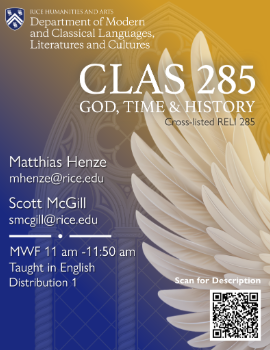
CLAS 285: GOD, TIME, & HISTORY
- Scott McGill and Matthias Henze
- MWF 11am - 11:50am
- Taught in English
- Distribution I Group
- Cross-listed with RELI 285
How is the passage of time given meaning, and what role--if any--is assigned to divinity in shaping the direction of events? Course explores various forms of recording and interpreting events, drawing from ancient Mesopotamia, Israel, and the Greco-Roman world--the cultures in which modern ideas of history began.
FREN 330: RHYTHMS AND SOUNDS IN FRENCH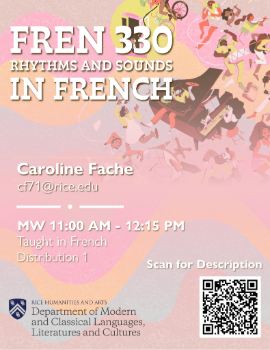
- Caroline Fache
- MW - 11am - 12:15pm
- Taught in French
- Distribution I Group
This course explores music as a cultural archive and social force across the French-speaking world. We will listen to, read, and analyze songs and sound cultures from French-speaking countries in France, the Caribbean, West and Central Africa, North Africa, Québec, Belgium, Switzerland, and the Indian Ocean, asking how rhythm, voice, language choice, and performance stage debates various social realities and challenges. Moving across genres such as chanson, rock, raï, zouk, hip-hop, rap, pop, electro, and Afropop/Afrobeats, the course treats music as both art and discourse, with attention to lyrics, music videos, live performance, and media ecosystems (radio, streaming platforms, and social networks). Students will practice close listening and close reading (in French and translation when useful), build a toolbox for analyzing sound and performance, and situate artists within the histories and politics that shape the Francophone world. Assignments can include a listening journal, short lyric analyses, a music video “shot-by-shot” commentary, a curated playlist with an annotated rationale, and a final creative-critical project such as a podcast segment or a short audio essay.
FREN 352: SHORT FICTION & FILM ADAPTATIONS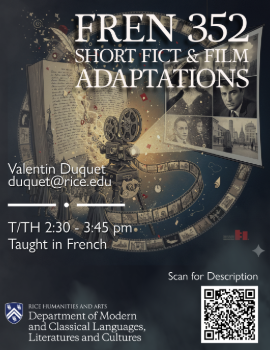
- Valentin Duquet
- TTh - 2:30pm - 3:45pm
- Taught in French
A comparative study of the masterpieces of French short fiction and their cinematic counterparts. From the 19th-century realism of Balzac and Maupassant to the 20th-century existentialism of Camus and Duras, this course examines how the intensity of the short form is translated to the screen. Students will analyze how legendary directors such as Jean-Pierre Melville, Yves Angelo, and Claude Chabrol interpret literary classics, focusing on the evolution of French narrative style, social critique, and visual storytelling.
GERM 281: POSTHUMANISM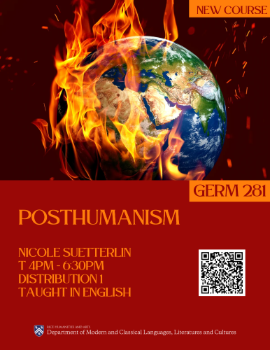
- Nicole Suetterlin
- T 4pm - 6pm
- Taught in English
- Distribution I Group
What does it mean to be human in the 21st century? This question lies at the heart of posthumanism, a fast-growing, transdisciplinary line of research that challenges the patriarchal, colonialist, and anthropocentric paradigms underlying the Western tradition. This course offers an introduction to cutting-edge redefinitions of the human body and self. With course materials spanning from bioscience and ecology to fiction and film, it places posthuman science and fiction in a gritty dialogue. We will grapple with defining the human in an age of increasing interdependencies between man, machine, and the environment, asking how science/fiction helps us develop ethical frameworks for our fast-moving 21st-century ecologies and technologies.
LALX 355: SPORTS IN LATIN/E AMERICA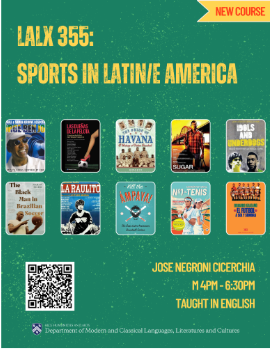
- Jose Cicerchia
- M 4pm - 6pm
- Taught in English
In this course, students will study some of the most critical twentieth- and twenty-first century books related to the dynamics of sport in Latin American and Latino cultures, which covers a vast hemisphere containing both Latin American and Latino communities, social inequality, oppression, laboratories for neoliberal policies, invasions, occupations, slavery and its legacies, institutionalized sexism, a history of militarization and human rights violations, caudillismo, and economic instability that have created the conditions for a complex yet vibrant sports landscape and allowed for the development of inordinately inventive athletes. In this context, we will focus, in particular, on how our course readings depict the various socioeconomic, racial, misogynistic and political aspects of the hemisphere’s sporting events. Among other topics, we will link the corporatization of baseball to American presence in the Caribbean, examine the waging of anti-migrant campaigns among sports franchises and address salary differentials between male and female soccer players. Students will explore the historical, political, economic, feminist and aesthetic debates on these topics through texts by Roberto González Echevarría, Claudia Piñeiro, David Zirin, Leonardo Padura, Dick Cluster, Osvaldo Soriano, Alan Bairner, Gabriela Cabezón Cámara, Anna Boden, Isaac Goldemberg, Eduardo Galeano, Brenda Elsey, David Goldblatt, and Juan Villoro, and others. As we will see, sports are an amazing art, but inseparable from the structures of power.
LALX 477 - SPECIAL TOPICS: RESISTANCE THROUGH BAD BUNNY 
- Luziris Pineda Turi
- MWF 1pm - 1:50pm
- Taught in English
The birth of reggaetón in the 1990s in Panama and Puerto Rico pushed the boundaries of sexuality and politics through lyrics that offered sexual liberation and political resistance. At the hands of Black musicians who represented working-class struggles, the genre centered the Afro-Latine experience and highlighted community issues. It is on the shoulders of these musical founders that the artist Bad Bunny is born and developed through a discography of lyrics and symbolism that represent the history and political struggles of Puerto Rico, push the boundaries of sexual identity, and speak to shared experiences of other communities facing similar struggles.While his focus begins on the island of Puerto Rico, as his music reaches the world, the message also becomes globalized and offers a lens through which to understand the universal struggles of colonization, capitalism, and misogyny shared across various communities. This course will explore these topics through the literary analysis of Bad Bunny’s musical production and the cultural analysis of his interviews and podcasts, underpinned by scholarly work aimed at understanding this phenomenon.
HUMA 143 - WHAT IS A BORDER?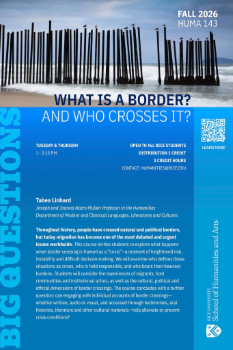
- Tabea Linhard
- TTh 1pm - 2:15pm
- Taught in English
- Distribution I Group
Throughout history, people have moved across natural and political borders, but migration has become one of the most contentious issues of our time. This course examines what happens when border crossing becomes a crisis—both a period of acute struggle, danger, or instability and a moment when difficult or consequential decisions must be made. We will consider who defines such situations as crises, who is deemed responsible, and who bears the heaviest burdens. Students will explore how different groups—migrants on the move, host communities, and institutional actors—experience border crossings, and how institutions shape, manage, or intensify these crises. The course concludes with a further question: can engaging with individual accounts of border crossings—whether written, audio, or visual, and accessed through testimonies, oral histories, literature, and other cultural materials—help alleviate or prevent crisis conditions?
Scholarship & Award Opportunities
The Leipzig Summer Fellowships
Through several generous endowments, the German Studies program offers the Leipzig Summer Fellowships. These fellowships allow students in the German Studies program, or German language students at Rice, to attend an eight-week, intensive summer language program at the University of Leipzig’s renowned Herder Institute. The fellowships are typically used for travel, housing, and tuition expenses in Leipzig. The fellowships are valued between $4,500 and $5,500 each. The courses students take in Leipzig count toward the requirements for the German Studies major (6 credit hours). Details about the Leipzig Summer Program, including information about housing, can be found here. For further information, contact the Program Advisor for German Studies, Fatima Baig.
Clyde Ferguson Bull Fellowship for Study Abroad in a French-speaking country
Ms. Clyde Ferguson Bull, a French major in the Class of 1926, endowed a fund that provides a fellowship for students to study in France or any country in which French is one of the official languages (e.g. Belgium, Morocco, Senegal, and many more), with a program approved by the French Studies program at Rice. The fellowship provides $12,000 per semester, $24,000 per year, or $6000 for a summer program. Rice financial aid will not be affected by this fellowship. Ideal candidates will be majors or minors in French Studies, as well as students whose academic and career goals will benefit from study abroad. We may offer a fellowship to several qualified candidates in any given period. Calls for applications are made every semester. For further information, contact the Program Advisor for French Studies, Caroline Fache.
Hispanic Endowment Travel Award
The Hispanic Endowment Travel Award provides financial support to graduating seniors who have majored or minored in Spanish and Portuguese or Latin American and Latinx Studies. The award is intended to support travel to a Spanish-speaking, Latin American, or Hispanic country for educational, cultural, or research purposes, fostering continued engagement with the languages, cultures, and communities students have studied throughout their academic careers. Calls for applications will be made every semester. For further information, contact the Department Chair, Jacqueline Couti.
Lost in Translation Award for Undergraduate Students
Translation is more than the transfer of words. It is an act of interpretation, creativity, and connection across cultures, disciplines, and communities.
We are delighted to share information about Rice's newest undergraduate student award, “Lost (and Found) in Translation: An Undergraduate Translation Prize." This new undergraduate award celebrates students who engage thoughtfully and innovatively with translation in all its forms — literary, cultural, scientific, artistic, and beyond.
The award is supported by the Department of Modern and Classical Languages, Literatures and Cultures, the Department of English and Creative Writing, the Humanities Research Center, and the Department of Transnational Asian Studies. All undergraduates may apply. For more information, reach out to Tabea Linhard.
The Max Freund Prize
Bestowed on seniors majoring in German Studies who have distinguished themselves by outstanding academic achievement. The current Max Freund Prize has a value of $500.
The Goethe Book Prize
Annually awarded to the most promising junior in German Studies.
The Kristine Wallace Prize
The Kristine Wallace Prize is awarded to a graduating major in Classics with an outstanding academic record who has contributed exceptionally to the program.
The André Bourgeois Award
This award is given to the most outstanding graduating major in French Studies. The current value of the award is $250.
Excellence in Latin American and Latinx Studies
This prize is awarded to a graduating major in Latin American and Latinx Studies with an outstanding academic record who has contributed exceptionally to the program. For further
Dates to Remember
JULY 2026:
- July 19 - Last day to take the LPT for the French, German, Italian, Portuguese, and Spanish languages.
Visit here for information.
AUGUST 2026:
- August 18 from 1 pm - 6 pm - Come meet your future instructors at the Academic Fair located at the Gibbs Recreation Center on the 2nd floor.
- August 24: First Day of Classes!
Contact Us
Do not hesitate to contact us if you have any questions.
General Inquiry Email: cultures@rice.edu
Events Email: mcllc.events@rice.edu
LPT Questions: mls17@rice.edu
Follow us on Instagram for more updates: @MCLLCRice